Most living rooms suffer from the same problem: harsh overhead light that makes the space feel cold and uninviting, or darkness punctuated by the glow of a TV. Ambient lighting changes that entirely. It’s the foundation of any well-designed living room, providing soft, diffused illumination that lets you relax comfortably while also setting the mood for entertaining. Unlike task lighting (which illuminates a specific activity) or accent lighting (which highlights architectural features), ambient lighting creates an enveloping glow that makes a room feel intentional and livable. Getting it right doesn’t require a designer’s budget or complicated rewiring, just smart planning and the right fixture strategy.
Table of Contents
ToggleKey Takeaways
- Ambient lighting is the foundation of any well-designed living room, providing soft, diffused illumination that replaces harsh overhead light and creates a warm, inviting atmosphere.
- Layering multiple light sources—such as ceiling fixtures, wall sconces, table lamps, and floor lamps—at different heights creates depth and visual interest while ensuring even light distribution throughout the space.
- Warm color temperatures between 2700K–3000K work best for living room ambient lighting, making the space feel welcoming while flattering skin tones and avoiding the clinical feel of cooler light.
- Installing dimmable fixtures allows you to adjust ambient lighting intensity throughout the day, from bright morning light to softer evening moods that create the perfect environment for relaxation and entertaining.
- Wall scones mounted at eye level (60–66 inches high) and uplighting techniques that bounce light off the ceiling provide glare-free illumination that feels cozier than ceiling-only lighting.
- Most homeowners can achieve the best results by combining 60–70% of light from a dimmer-controlled ceiling fixture with 15–20% from wall sconces and 10–15% from table lamps for balanced, three-layer ambient lighting.
Why Ambient Lighting Matters in Your Living Room
Ambient lighting is your room’s foundation layer. Without it, everything else, your furniture, artwork, and color scheme, looks flat and uninviting. Good ambient lighting does several things at once: it fills the room with even, comfortable light: it reduces eye strain by eliminating harsh shadows: and it makes the space feel larger and more open.
The living room is where families gather, guests are entertained, and you spend hours relaxing. That means the lighting needs to adapt throughout the day and evening. Morning sunlight bounces off walls differently than evening lamplight. A room that looks great at 6 p.m. might feel gloomy at 8 p.m. without proper ambient illumination.
Proper ambient lighting also protects your furniture and flooring. When light is too concentrated in one area, it can fade fabrics unevenly. Distributed, diffuse light wears colors more evenly over time. Beyond aesthetics, well-lit rooms feel safer and more comfortable, studies consistently show that people feel anxious in poorly lit spaces, even if they can’t identify why.
Understanding Ambient Lighting Basics
Ambient lighting works on a few core principles: even distribution, warm color temperature, and dimmability.
Color Temperature matters more than most homeowners realize. Measured in Kelvin (K), it ranges from warm (2700K–3000K, which looks like candlelight) to cool (5000K+, which looks like daylight). For living rooms, stick with 2700K to 3000K, warm white light that feels welcoming and makes skin tones look flattering. Cooler light works in kitchens and offices but will make your living room feel like a dentist’s waiting room.
Layering is the secret to ambient lighting that actually works. A single overhead fixture creates a flat, one-note look. Instead, combine several light sources at different heights: ceiling fixtures, wall sconces, table lamps, and floor lamps. Each layer contributes a portion of the total light needed, and together they create depth and visual interest.
Dimmability is essential. A room lit at full brightness at 9 a.m. doesn’t need the same intensity at 9 p.m. Install dimmer switches on your main ambient light source so you can adjust the mood throughout the day. Most LED bulbs work with dimmers now, though you’ll want to buy dimmable LEDs specifically, cheap LEDs may flicker or hum on dimmers.
Also consider the size of your living room. A small 150-square-foot room won’t need the same lumens (brightness) as a sprawling 400-square-foot living room. A rough rule: aim for 10–20 lumens per square foot for ambient lighting in living spaces. That’s about 1,500–2,000 lumens for a typical 150-square-foot room.
Best Light Fixtures for Living Room Ambiance
Overhead and Recessed Options
Overhead fixtures are the backbone of ambient lighting, but choosing the wrong one can ruin a room. Avoid flat, bare bulb ceiling fixtures, they cast harsh shadows and feel institutional. Instead, look for flush mounts or semi-flush fixtures that diffuse light through a shade or frosted glass.
Recessed lighting (also called can lights) works beautifully for ambient light if installed correctly. Spread them evenly across the ceiling in a pattern that covers the whole room without dark corners. Most recessed lights are spaced 4–6 feet apart for even coverage. Use 3000K warm white bulbs and install them on a dimmer for flexibility. Recessed lighting requires roughing in the electrical and cutting ceiling holes, so it’s best done during renovation or if you’re comfortable with drywall repair.
Chandeliers are often overlooked for ambient light, but a well-chosen multi-light model can be stunning. A chandelier with 4–6 softly diffused bulbs provides gentle light while adding visual interest above the seating area. Transform your space with multi-light chandeliers if you want a statement piece that also illuminates the room.
Recessed lighting housing requires careful planning, you’ll need to know your joist layout and have a clear path for running electrical, so this is worth consulting an electrician before committing.
Wall Sconces and Indirect Lighting
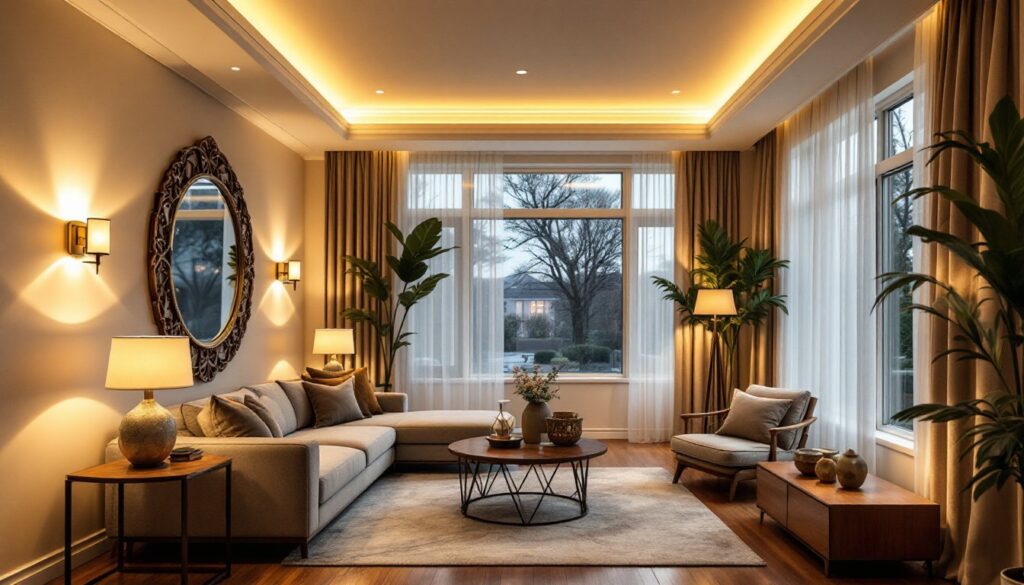
Wall sconces flank a sofa or bookshelf and provide light at eye level, reducing glare and creating a cozier feel than ceiling-only lighting. Mount them 60–66 inches above the floor (roughly eye height when seated) on either side of a focal point.
Uplighting is an elegant indirect technique: place floor lamps or wall-mounted fixtures that direct light upward toward the ceiling. The ceiling then acts as a reflective surface, scattering soft, diffuse light throughout the room. This creates a warm glow without harsh shadows.
Cove lighting, hidden LED strips tucked into crown molding or architectural ledges, is a more advanced option that creates a floating effect. It requires planning during construction or renovation, but the result is exceptionally sophisticated.
Visual Comfort Lighting Fixtures are engineered specifically to reduce glare while distributing light evenly, a real benefit if you’re dealing with sensitive eyes or reflective surfaces like glass furniture.
Layering Techniques for Perfect Living Room Lighting
The best ambient lighting uses at least three layers: ambient (general overhead), task (for reading or working), and accent (highlighting decor or architecture). But for ambient-focused design, you’re primarily stacking ambient sources.
Start with your ceiling fixture, a dimmer-controlled flush mount or recessed system providing 60–70% of your target lumens. Add wall sconces on either side of a mirror or artwork for an additional 15–20%. Fill the remaining 10–15% with table lamps on side tables next to seating. This way, if you turn off the ceiling light, the room still feels lit and inviting with the sconces and lamps.
Spacing matters. If sconces are too close together or lamps cluster in one corner, you’ll create pockets of bright light and shadow. Distribute fixtures around the perimeter and at varying heights. According to expert living room lighting ideas, the most successful rooms balance these layers deliberately rather than adding random fixtures.
Consider furniture placement before installing anything permanent. A beautiful sconce looks awkward if a tall bookshelf blocks its light. Wall lamps work best on walls without large windows, as daylight changes the dynamic throughout the day. Use temporary floor lamps during the planning phase to see how light moves through the room before committing to electrical work.
Decorative lighting fixtures should support the overall layering strategy, not compete with it. Choose pieces that coordinate in finish (brushed brass with brushed brass, matte black with matte black) so the room feels cohesive rather than eclectic.
DIY Installation Tips for Homeowners
If you’re upgrading existing fixtures or adding new sconces, here’s what to know before you start:
For Ceiling Fixtures: Turn off power at the breaker (flip the breaker, test the switch with a lamp to confirm it’s off). Remove the old fixture, label the wires with painter’s tape (black to black, white to white, ground to ground). If you’re installing a heavier fixture than the original, anything over 50 pounds, check that your electrical box is rated for the weight. Many existing boxes aren’t. A new fan-rated box or brace-kit ($20–40) solves this. LED lighting in bedrooms demonstrates how proper installation supports long-term performance.
For Wall Sconces: Locate studs with a stud finder before drilling into drywall. Sconces should mount into studs whenever possible for stability. If you’re mounting between studs, use heavy-duty drywall anchors rated for the fixture’s weight. Mark the height with a pencil, then use a level to ensure the fixture is perfectly horizontal, even a quarter-inch off looks wrong.
For Electrical Work: If you’re running new circuits or adding outlets, this is where you might hit code requirements. Most jurisdictions require a permit for new outlets in living spaces. Check with your local building department before wiring anything permanent. NEC (National Electrical Code) requirements vary by region, but general rules include proper wire gauges for the amperage and GFCI protection in damp areas.
Safety Gear: Wear safety glasses when working overhead (dust and debris fall). Use gloves for handling sharp electrical connectors. If cutting drywall for recessed lights, a dust mask prevents drywall powder inhalation.
For most homeowners, hiring an electrician to install new circuits or move heavy fixtures is worth the cost, typically $75–150 per fixture for labor, to avoid code violations and the risk of fire or shock. Installing LED bulbs and using existing outlets for lamps? That’s pure DIY territory and risk-free.
<h2 id="” data-id=””>Putting It All Together
Ambient lighting transforms a living room from a dark, uninviting box into a warm, livable space. Start by assessing what you have now: Is your ceiling light too harsh? Are there dark corners? Do you have enough flexibility to dim and brighten throughout the day? Then layer in sconces, uplighting, or additional ceiling fixtures to build depth and visual warmth.
The best designs often start with a budget and a plan. Sketch your room layout, mark stud locations, measure heights, and identify where each layer of light will come from. Stoddardcarpets.com and Homedit both showcase living room designs that demonstrate layered lighting in action. Take inspiration from rooms that match your space and style, then adapt the principles to your needs. Your living room should feel like home, and the right ambient lighting is the quickest way to get there.