Your outdoor sign sits in darkness after sunset. Without proper lighting, potential visitors miss it entirely, and your home’s street presence disappears. Outdoor sign lighting transforms curb appeal by making your address or business signage visible, welcoming, and professional-looking 24/7. Whether you’re looking to highlight an address sign, directional sign, or decorative marker, the right lighting approach combines visibility with energy efficiency and weather durability. This guide covers seven practical outdoor sign lighting ideas that work for modern homes, from LED spotlights to smart controls, so you can choose what fits your budget and style.
Table of Contents
ToggleKey Takeaways
- LED spotlights deliver superior brightness while using 8-15 watts compared to 50-75 watts for halogen alternatives, with a lifespan of 25,000+ hours for long-term cost savings.
- Outdoor sign lighting ideas range from solar-powered fixtures that require zero wiring to wired LED systems with smart controls for maximum flexibility and energy efficiency.
- Proper fixture placement at a 30-45 degree angle 4-6 feet from the sign ensures even illumination without creating glare that bothers neighbors.
- Weatherproof fixtures rated IP65 or higher with aluminum, stainless-steel, or galvanized housings protect against freeze-thaw cycles, salt exposure, and UV damage for durability lasting 5+ years.
- Smart lighting controls with motion sensors and automated schedules reduce energy consumption by 50-60% while providing convenient phone or voice-assistant management of outdoor sign lighting.
- Address signs benefit from combined front and side lighting at 30-45 degrees to prioritize readability, while decorative signs shine with uplighting that creates sculptural shadow effects.
LED Spotlights for Maximum Visibility and Energy Savings
LED spotlights are the workhorse of sign lighting. They deliver bright, focused light with minimal power draw, typically 8-15 watts for a quality fixture compared to 50-75 watts for halogen equivalents. LEDs also last 25,000+ hours, meaning you’ll replace them far less often than incandescent or halogen bulbs.
When choosing an LED spotlight, look for a color temperature between 3000K and 4000K (warm to neutral white). This range enhances readability without creating harsh glare that fatigues the eye at night. A CRI (Color Rendering Index) of at least 80 ensures your sign’s colors and details look true to life under the light.
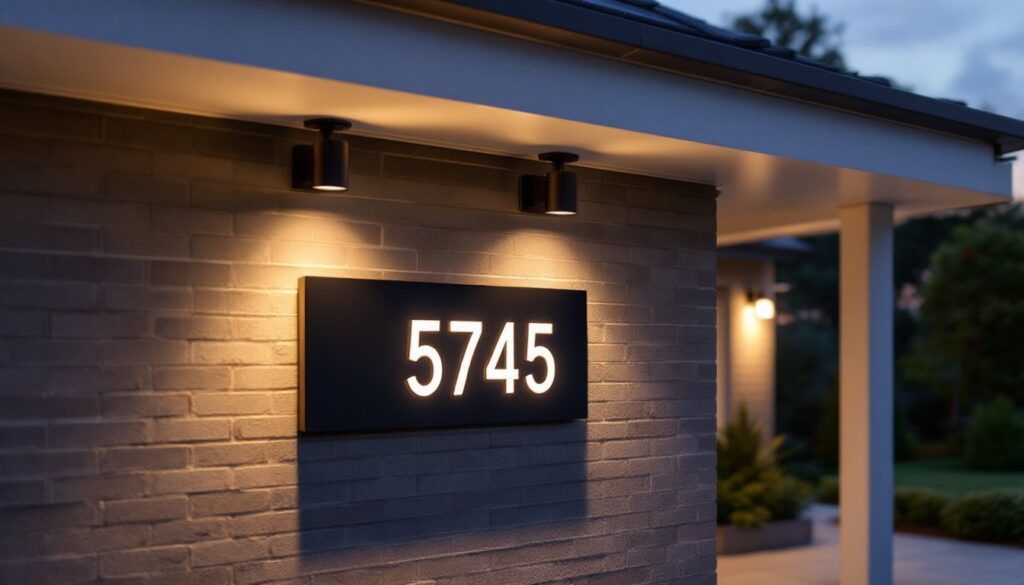
Installation is straightforward. Mount the fixture 4–6 feet from the sign at a 30–45-degree angle to avoid direct glare into neighbors’ eyes. Angle the beam so light hits the sign face evenly, not the edges or surrounding areas. For address signs, a single 15–20-watt LED spotlight usually suffices: larger commercial signs may need two fixtures.
LED spotlights also pair well with outdoor ceiling lighting on covered porches or entryways, creating a cohesive lighting scheme. Use a weatherproof junction box and outdoor-rated wiring (UF-B cable buried 18 inches deep if running underground, or conduit if above ground). Always follow local electrical codes, running new circuits may require a permit.
Solar-Powered Sign Lights for Eco-Friendly Homes
Solar sign lights offer true plug-and-play convenience. No wiring, trenching, or electrical permits needed, just mount the fixture, ensure it gets direct sun during the day, and let the integrated solar panel charge a rechargeable battery that powers the LEDs at night.
Quality matters here. Cheap solar fixtures often fail after one season because the battery degrades or the panel doesn’t generate enough charge on cloudy days. Look for models with at least 600 mAh battery capacity and panels rated for at least 2 watts. Brands focusing on durability include those with aluminum housings and sealed battery compartments to prevent moisture intrusion.
Placement is critical. The solar panel must receive at least 6 hours of direct, unobstructed sunlight daily. If your sign is on the north side of a house or under tree shade, solar won’t work reliably. Mount the panel facing the strongest sun exposure, even if it means angling it differently from the sign itself.
Adjustable Brightness Options
Many modern solar fixtures include a brightness dial or button to dial down light output, which extends battery life on shorter nights or reduces overbrightness in small yards. Some higher-end models even offer motion sensors, activating full brightness only when movement is detected and dropping to 20–30% during idle periods. This cuts battery drain significantly and works great for security-focused homeowners.
Solar sign lights work especially well paired with broader solar street lighting strategies on properties with multiple outdoor zones. But, don’t expect solar alone to match the punch of a wired LED spotlight in high-visibility situations. For address signs on busy roads or larger decorative markers, solar is excellent: for commercial or high-traffic signage, wired LED is more reliable.
Uplighting and Downlighting Techniques
Uplighting and downlighting are directional lighting strategies that create visual drama and depth around signage.
Uplighting points the fixture upward, creating a silhouette or halo effect behind or above the sign. This technique works beautifully on signs mounted on walls or posts. Position the light source 2–4 feet below the sign, angled up at 45–60 degrees. The light grazes the sign’s surface and extends upward, making the sign pop against the night sky while adding architectural interest to the structure behind it. Uplighting is especially striking on decorative address plaques, carved signs, or illuminated house numbers.
Downlighting points the fixture down from above, washing the sign with light from overhead. This is the classic approach for recessed or surface-mounted lights on a porch soffit or overhang. Downlighting delivers uniform, glare-free illumination, perfect for readability. The trade-off: it lacks the drama of uplighting and can create shadows if the light angle is too steep.
For best results, use 2–3 watt LED spotlights per technique: one uplight and one downlight on a prominent sign creates balanced, layered visibility. Match color temperatures so the light feels cohesive, don’t mix warm and cool tones. A dimmer or smart control lets you adjust brightness and even switch between uplighting and downlighting modes depending on time of day or season, adding flexibility to your outdoor sign lighting strategy.
Smart Lighting Control Systems for Your Outdoor Signs
Smart outdoor lighting brings convenience and energy savings to sign illumination. WiFi-enabled or Zigbee fixtures let you control brightness, on/off schedules, and even color temperature from your phone or voice assistant.
The main benefit: automated schedules. Set lights to turn on at sunset and off at 11 PM or midnight, reducing unnecessary energy use on nights when foot traffic is low. Geofencing features can turn lights on when you arrive home and off when you leave, without manual switches.
For sign lighting specifically, smart controls excel at motion-triggered activation. A fixture with a built-in sensor activates at full brightness when movement is detected (useful for address signs along walkways or driveways) and drops to 10–20% standby brightness otherwise. This cuts energy consumption by 50–60% compared to fixtures that run all night at full power.
Compatible ecosystems include Philips Hue outdoor, Nanoleaf, and other platforms that integrate with Alexa or Google Home. Installation is standard, mount the fixture like any outdoor light, connect to your WiFi network via the app, and configure automations. Most smart outdoor fixtures cost $40–$80 each, a modest premium over dumb LED spotlights. They’re worth it if you value convenience and have reliable home WiFi coverage.
Note: smart systems require a dedicated outdoor circuit and GFCI (ground-fault circuit interrupter) protection, mandatory in most jurisdictions. Check local code or hire a licensed electrician if you’re unsure about safe installation.
Weatherproof Fixtures That Last Through the Seasons
Outdoor lighting endures freeze-thaw cycles, rain, UV exposure, and temperature swings. A fixture rated IP65 or higher ensures water and dust ingress protection, essential for sign lighting. IP65 means dust-tight and water-jet-proof: IP67 adds temporary immersion protection (up to 1 meter for 30 minutes).
Material matters. Aluminum or stainless-steel housings resist corrosion better than plastic or painted steel. If steel is used, confirm it’s hot-dipped galvanized or powder-coated to prevent rust. Gaskets and seals should be silicone or rubber, not foam, so they maintain flexibility through temperature extremes and don’t degrade under UV.
Look for impact-resistant polycarbonate or tempered glass lenses, not acrylic, which yellows and becomes brittle over time. Wire connections must be soldered or crimp-sealed (not twisted), housed inside a sealed terminal block or junction box. Avoid fixtures with exposed screw terminals, water creeps in over time.
Where you live matters too. Coastal properties need marine-grade stainless or powder-coated aluminum because saltwater accelerates corrosion. Cold climates benefit from fixtures with wide operating ranges (typically −20°F to 120°F or broader). Heavy snow areas should avoid fixtures with design flaws that trap snow or ice. A sloped or beveled top helps snow slide off without pooling.
Budget accordingly: quality weatherproof LED fixtures cost $30–$80 versus cheap alternatives at $10–$20. The difference shows within 1–2 seasons. A fixture that needs replacement every year costs more in labor and replacement parts than one lasting 5+ years. Pair robust fixtures with outdoor wall lighting designs that also prioritize durability, and your entire outdoor lighting scheme will age gracefully.
Design Tips for Highlighting Your Outdoor Signage
Effective sign lighting is as much about design intent as technical specs. Start by asking: what’s the sign’s primary purpose? Address visibility? Decorative appeal? Wayfinding? Your answer shapes fixture choice and placement.
For address signs, prioritize readability. Aim light directly onto numbers or letters at a slight angle (30–45 degrees) to create contrast without glare. Avoid backlighting alone, it silhouettes the sign but obscures the actual text. A combination of front and side lighting works best.
For decorative or carved signs, uplighting creates sculptural shadow play and emotional impact. Warm white (2700K–3000K) light enhances wood tones and natural materials: cooler light (4000K–5000K) suits modern or metal signs.
For large commercial signs, spacing matters. The Illuminating Engineering Society (IES) recommends foot-candles, a measure of light intensity, between 5–10 for typical residential sign lighting. For reference, one 15-watt LED spotlight on an address sign roughly delivers 8–12 foot-candles at 4 feet distance. Adjust based on sign size and surroundings.
Consultation resources like Hunker and The Spruce offer design inspiration and practical guidance on layout. Scale your lighting to the sign’s visual weight: a small brass plaque needs less light than a large wooden sign. Symmetry helps, two fixtures flanking a sign feel balanced: one centered fixture works for small plaques.
Finally, consider neighbors. Light pollution rules are increasingly strict in residential areas. Shield light downward and toward the sign, not outward into the street or onto adjacent properties. Dark-sky-friendly fixtures have flat-glass lenses or louvered shields that direct light where you need it, reducing spill and glare. This is considerate design and often required by municipal code.