Art Deco pendant lighting brings sophistication and geometric flair to any room without requiring a complete renovation. These statement fixtures combine clean lines, bold angles, and metallic finishes that work beautifully in both vintage-inspired and contemporary spaces. Whether you’re updating a kitchen island, hallway, or bedroom, art deco pendants deliver visual impact while maintaining practical task lighting. Unlike trendy decor that fades in a season, this style has remained relevant for over a century, and designers predict it’ll stay strong through 2026 and beyond. If you’re ready to add some architectural character to your home, understanding what makes these fixtures tick is the first step.
Table of Contents
ToggleKey Takeaways
- Art deco pendant lighting brings geometric sophistication and timeless style to modern homes without requiring renovation, working seamlessly in kitchens, entryways, and bedrooms.
- These fixtures balance form and function with clean lines, metallic finishes, and frosted or patterned glass that work equally well in contemporary minimalist and mid-century modern spaces.
- Proper sizing and placement are critical—pendants should occupy roughly one-third the visual weight of the surface below, mounted 30 to 36 inches above countertops to eliminate glare while providing task lighting.
- Choose materials based on durability and aesthetics: brass develops warm patina over time, chrome stays reflective, and tempered frosted glass resists thermal shock and hides dust better than clear glass.
- Verify fixture compatibility with LED bulbs (40 to 60-watt equivalent lasting 25,000+ hours) and confirm whether dimming support is available before purchase, especially for bedrooms and dining areas.
- Hardwired installations require a licensed electrician, while plug-in pendants work only if ceiling outlets already exist—consult a professional before purchasing to ensure compatibility with your home’s electrical setup.
What Defines Art Deco Pendant Lighting
Art Deco emerged in the 1920s and 1930s as a design movement that rejected ornate Victorian excess. Instead, it embraced geometric shapes, symmetry, and machine-age materials like chrome, brass, and glass. Art Deco pendant lights typically feature one or more of these characteristics: angular silhouettes, stepped or tapered forms, sunburst patterns, and a color palette of black, gold, brass, or chrome against clear or frosted glass.
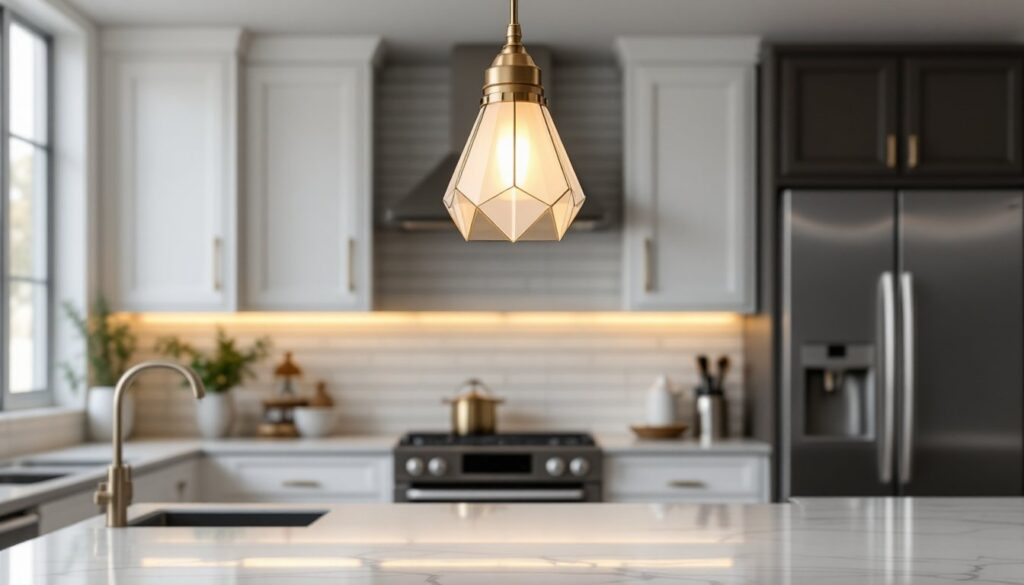
What separates art deco pendants from other styles is the deliberate emphasis on form as function. A fixture isn’t just a light source, it’s an architectural element. You’ll see chevron patterns, triangular brackets, and faceted glass. Frosted or patterned glass diffusers scatter light evenly while adding visual interest. The canopy (the part that mounts to the ceiling) often features geometric detailing too, not just the shade.
These fixtures use standard Edison bulbs or modern LED equivalents, making them practical for everyday use. A single 8-inch to 14-inch pendant works best over most counters: larger industrial spaces might call for coordinated multiples. The key is proportion, the pendant should occupy roughly one-third of the visual “weight” of the surface below it.
Why Art Deco Pendants Work for Modern Homes
Modern homes don’t typically embrace maximalism or overstuffed ornamentation, yet art deco pendants fit right in. The style trades fussy detail for clean geometry, which aligns perfectly with contemporary minimalist and mid-century modern aesthetics. That’s why you’ll see art deco lighting in Scandinavian-inspired kitchens and sleek urban lofts.
These pendants also bridge old and new without feeling either dated or trendy. A black art deco fixture over a white subway-tiled kitchen island feels timeless, not retro. The geometric vocabulary speaks to people who appreciate good design: proportional, purposeful, and honest about materials.
From a practical standpoint, most art deco pendants come in 3000K to 4000K color temperatures (warm to neutral white light), which flatters food, faces, and finishes. The focused downward light works well for task areas. A 40 to 60-watt equivalent LED bulb provides ample brightness without drawing excessive power. Transform Your Space: The explores how lighting fundamentally changes a room’s mood and function.
Popular Styles and Materials to Consider
Art Deco pendant styles span a range, each with its own character. Sunburst pendants feature radiating lines that evoke the sun, classic, instantly recognizable, and bold. Geometric cage pendants use open metal frames to create a sculptural effect while avoiding a heavy appearance. Frosted glass domes with brass or chrome trim offer understated elegance, letting the form speak quietly. Tapered hexagonal or triangular shades add modernist punch.
Material matters for durability and aesthetics. Brass develops a warm patina over time: chrome stays reflective and cool. Steel offers durability without the price tag of solid brass. Frosted or satin-finish glass softens harsh light and hides dust better than clear glass. Avoid low-quality thin glass that feels flimsy, look for fixtures labeled tempered glass, which resists thermal shock if you’re installing above a heat source like a range.
Glass vs. solid metal is a budget decision. All-metal fixtures run cheaper and work in industrial settings: glass-and-metal combos provide visual interest and better light diffusion. According to Art Deco Interior Design resources, the finest contemporary examples blend brushed metals with clear or frosted glass.
For a cohesive look, Transform Your Space with Multi-Light Chandeliers: Style, Function, and Elegance demonstrates how pairing fixtures creates visual rhythm across a home.
Where to Install Art Deco Pendant Lights
The best locations for art deco pendants balance visibility, function, and style impact. These fixtures shine in high-traffic areas where they become conversation pieces, not afterthoughts.
Kitchen Islands and Dining Areas
A kitchen island is the gold standard for pendant lighting. Mount two to three pendants in a line, spaced 24 to 30 inches apart, with the lowest point of the shade sitting 30 to 36 inches above the countertop. This height keeps glare out of sightlines while providing task lighting for prep work and dining. If your island is particularly long (over 6 feet), space is more critical than number, pendants spaced too far apart look intentional: too close, they look cramped.
Dining tables benefit from a single centered pendant or a small cluster. Use the same 30-inch clearance rule above the table. Avoid pendants directly over seated heads, people stand to reach food, but diners shouldn’t duck around fixtures. Frosted glass diffusers work especially well here, creating soft ambient light for evening meals.
Entryways and Bedrooms
Entryways need visual punch. A single oversized art deco pendant (12 to 16 inches) announces style immediately. Since entryways aren’t task-lit zones, you can prioritize aesthetics: a more ornate sunburst or geometric cage works here. Mount it 6.5 to 8 feet high to clear doorframes and avoid head-bumping in homes with lower ceilings.
Bedrooms are trickier. A pendant over a bedside table (instead of a wall sconce) adds geometry and frees wall space, but ensure the light is dimmable and warm-toned for sleep-friendly ambiance. A single smaller pendant (8 to 10 inches) flanked by the bed works better than one centered overhead, which can feel institutional. Consider the color of your walls and linens, a brushed gold pendant against cool gray bedding creates elegant contrast: chrome on warm beige risks clashing. Wooden Nickel Lighting: Transform showcases how different finishes suit various room palettes.
How to Choose the Right Fixture for Your Space
Start with scale. Measure your ceiling height and the width of the area being lit. A 40-foot-long industrial loft can support a 16-inch oversized pendant: a 9-foot standard kitchen won’t. As a rough guide, the pendant diameter should be roughly one-third the width of the surface below. An island 3 feet wide pairs well with 10 to 12-inch fixtures.
Next, consider finish in context. Polished brass and chrome work in bright, modern kitchens. Matte black pendants suit moody, eclectic spaces. Bronze finishes bridge traditional and contemporary. Hold a paint chip from your cabinetry or wall up to the fixture’s finish, the contrast should feel intentional, not accidental.
Bulb type matters for future maintenance. LED bulbs last 25,000+ hours, saving on replacements. Ensure the fixture is rated for LED (older art deco designs sometimes had compatibility issues). A 40-watt equivalent or 60-watt equivalent LED suits most kitchen islands: bedrooms and dining areas often look better with dimmable bulbs, so verify the fixture supports dimming and select a dimmable LED.
Finally, verify the hardwired or plug-in option. Hardwired fixtures require running electrical wire through the ceiling, a job for a licensed electrician if your ceiling lacks a junction box. Plug-in pendants work if you have a ceiling outlet already in place. Neither option is “easier”, it depends on your existing wiring. If uncertain, consult an electrician before purchase. Installers at Design Milk and other design-focused retailers often provide guidance on fixture compatibility with your home’s layout.