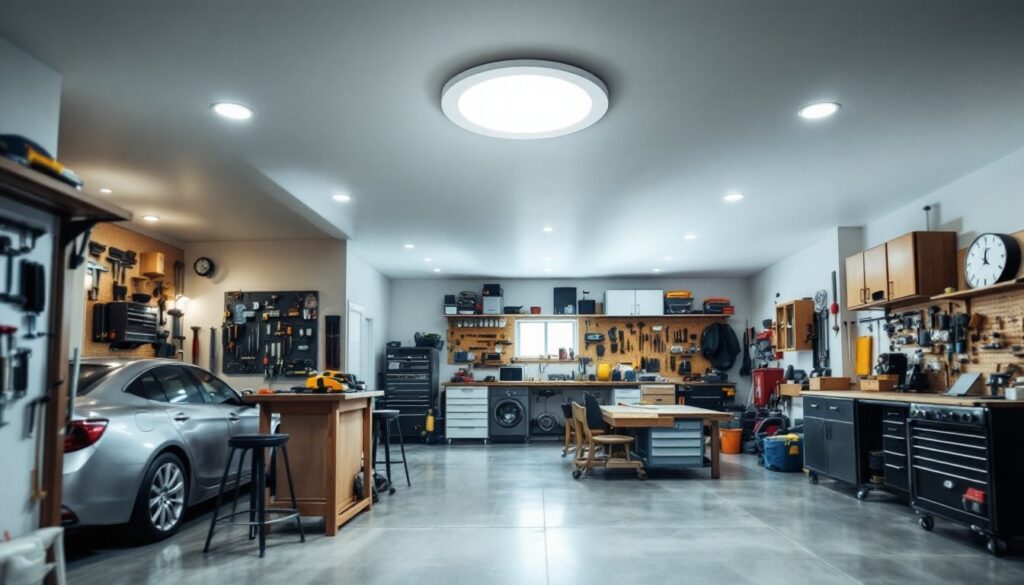
A dark, shadowy garage makes every project harder, finding tools takes twice as long, and working on anything requires squinting and guessing. Recessed lighting changes that equation entirely. Unlike bulky overhead fixtures or clamp-style shop lights, recessed lights sit flush with the ceiling, giving you clean sightlines and shadow-free work areas. If you’re tired of your garage feeling like a cave, strategic recessed lighting is one of the smartest upgrades you can make. This guide walks you through why recessed lights work so well for garages, how to pick the right fixtures, where to place them, and how to install and maintain them properly.
Table of Contents
ToggleKey Takeaways
- Recessed lighting provides even, shadow-free illumination across your entire garage workspace without bulky fixtures or obstructions, making it ideal for workbenches, tool storage, and hobby spaces.
- Choose recessed lights with remodel housings, cool white 4000K–5000K color temperature, and 40–50 lumens per square foot (typically 4–6 fixtures for a single-car garage) to eliminate dark zones and reduce eye strain during detail work.
- Plan your recessed lighting layout carefully by measuring your garage, marking joist locations, spacing fixtures 4–6 feet apart, and testing positions with chalk or tape before installation to avoid costly repositioning.
- Installation requires careful electrical work including cutting drywall holes, routing wiring to code, securing housings, and making proper wire connections—hire a licensed electrician if unfamiliar with electrical code.
- LED recessed lights are energy-efficient and low-maintenance, lasting 25,000+ hours and requiring only occasional cleaning and annual checks for loose housings and corrosion-free connections.
- Recessed garage lighting combined with task lighting at workbenches creates a versatile, professional-grade workspace that transforms productivity and safety while delivering reliable illumination for decades.
Why Recessed Lighting Works Best for Garages
A garage isn’t just a parking spot, it’s a workshop, storage hub, and sometimes a gym or hobby space. That means you need bright, even illumination without distracting shadows or glare bouncing off your workbench. Recessed lights do this naturally.
They distribute light evenly across the entire ceiling plane, eliminating the dark pockets that pendant lights or single ceiling fixtures create. Because the light source sits inside the ceiling cavity, there’s no dangling fixture to work around or bump your head on. For garages with 8- or 9-foot ceilings, this flush placement is a game-changer.
Recessed lights also scale well. A single overhead fixture can’t reliably light a two-car or three-car garage, but a grid of recessed cans provides consistent, layered coverage. You can also install dimmers or separate circuits to control light intensity based on the task, bright white light for mechanical work, slightly dimmer ambient light when you’re just grabbing tools.
Finally, recessed fixtures are energy-efficient, especially with LED bulbs. You’ll use less electricity than with traditional fluorescent shop lights, and LEDs last far longer (25,000+ hours), reducing maintenance headaches.
Choosing the Right Recessed Light Fixtures for Your Garage
Not all recessed lights are created equal. Garage-specific fixtures need to handle temperature swings, dust, and potential moisture, especially if your garage isn’t climate-controlled or you live in a humid region.
Trim and Housing Considerations
Recessed lights come in two main forms: “new construction” and “remodel” housings. New construction housings are nailed or screwed to ceiling joists before drywall goes up. Remodel housings sit inside existing drywall with spring clips that grip the drywall from inside. Since most homeowners are working with finished ceilings, remodel housings are your go-to choice.
For trim (the visible ring around the bulb), baffle trims reduce glare and are ideal for garages where you’ll be looking up at lights while working. Reflector trims maximize light output, useful if your garage ceiling is dark or you want maximum brightness. Avoid cheap trim kits: they can vibrate loose or rust over time.
Recessed vs. Other Garage Lighting Options
Recessed lighting isn’t the only choice, and context matters:
- Recessed lights: Even coverage, flush-mounted, scalable, professional look. Best for finished ceilings and planned layouts.
- Fluorescent shop lights: Affordable upfront, bright, good for unfinished basements or garages with exposed joists. Bulkier and harder to replace when fixtures fail.
- Track lighting: Flexible and adjustable. Works well if you need to redirect light toward a specific workbench, but typically covers less area overall.
- Linear LED panels: Modern, efficient, and increasingly affordable. Good middle ground between recessed lights and shop lights if you want easy retrofit options.
For most residential garages with finished or semi-finished ceilings, recessed lights offer the best balance of aesthetics, function, and durability. They’re also the easiest to upgrade later if you switch to brighter or dimmable bulbs.
Lumens and Color Temperature
Garages need brightness. Aim for 40–50 lumens per square foot of usable space. A standard 60-watt incandescent-equivalent LED (around 800 lumens) works well for single cans: you’ll typically install 4–6 cans for a single-car bay, more for larger spaces.
Choose 4000K to 5000K color temperature (cool white). This mimics daylight and reduces eye strain during detail work. Warm white (2700K) looks cozy in living rooms but makes it harder to see fine details in a garage. Look for fixtures rated IP44 or higher for dust and moisture resistance, especially important in garages where humidity or condensation might occur seasonally.
Planning Your Recessed Lighting Layout
A haphazard grid of lights won’t eliminate shadows: a thoughtful plan will. Spend time sketching your garage on paper or using a simple floor-plan app.
Measure and Map
Start with exact dimensions of your garage. Mark the location of any existing electrical boxes, HVAC ducts, or plumbing that might block recessed housing. Check overhead joist spacing (typically 16″ or 24″ on center). Recessed lights fit between joists, so your layout must work with the framing.
For a single-car bay (roughly 10′ × 20′), a 2 × 3 or 2 × 4 grid (spaced 4–6 feet apart) provides even coverage. For a two-car garage (roughly 18′ × 20′), aim for a 3 × 4 or 4 × 4 grid. Space fixtures roughly 4–6 feet apart, closer spacing ensures no dark zones, wider spacing saves money if your ceiling height allows it.
Account for Workbenches and Hazards
If you have a workbench, position at least one light directly above it or slightly in front to minimize your shadow. Avoid putting lights directly over your head if you’re standing on a ladder, working in your own shadow is maddening.
If you park cars in the garage, don’t put lights so low (in very low ceiling installations) that they’ll be blocked or create a hazard. An 8-foot ceiling with recessed lights is usually fine: a 7-foot ceiling gets risky.
Test Before You Commit
Before drilling any holes, lay out your fixture positions with chalk or tape on the ceiling. Stand back, imagine the light distribution, and ask yourself: “Will the corners be dark? Will there be glare over the workbench?” If possible, ask a friend to hold a portable work light at proposed locations to visualize coverage. This simple step saves you from costly repositioning later.
Consider also whether you want a recessed lighting housing that suits a finished or unfinished space, as this affects your retrofit options and upgrade flexibility.
Installation Essentials for Garage Recessed Lights
Installation difficulty depends on whether you’re working in a finished or unfinished ceiling. Both are doable for competent DIYers, but electrical work may require a licensed electrician in some jurisdictions. Always check local building codes before starting.
Tools and Materials
- Drywall saw or hole saw (diameter matches fixture size, typically 4″ or 6″)
- Stud finder and level
- Voltage tester
- Wire strippers and wire connectors
- Recessed light housings and trim rings
- LED bulbs (rated 4000K–5000K, 800–1100 lumens)
- 12 AWG or 14 AWG electrical wire (check local code)
- Electrical junction boxes and conduit (if required)
- Drywall compound and sandpaper (for finished ceilings)
Step-by-Step Installation (Finished Ceiling)
- Mark and verify positions using your floor plan. Double-check that you’re not cutting into joists or existing wiring. Use a stud finder to confirm safe zones.
- Cut holes at marked positions. A drywall saw gives you better control than a hole saw, especially if you’re cutting near electrical lines. Wear safety glasses, dust falls directly on you.
- Route electrical wire to each fixture location. This is the step most homeowners hire out. If you’re unfamiliar with electrical code, NM-cable (Romex) routing, or breaker sizing, call a licensed electrician. Garage circuits often require GFCI protection if they’re near moisture sources.
- Insert recessed housings into each hole. Remodel housings have spring clips: twist or push them to lock the housing in place. Ensure housings are flush with the ceiling and level.
- Make wire connections inside the housing junction box. Strip about 3/8″ of insulation from the end of each wire, insert into a push-in connector or wire nut, and twist clockwise. All connections must be inside the housing, never leave exposed terminals.
- Install trim rings and bulbs once all housings are secure. Push trim rings up into the housing until they click, then screw in your LED bulbs.
- Test all fixtures with the breaker on before finishing walls or returning furniture.
Safety Reminders
- Turn off power at the breaker before touching any wiring. Use a voltage tester to confirm the circuit is dead.
- Wear gloves when handling insulation or sharp drywall edges.
- Don’t cram wiring into housings, overcrowding creates heat buildup and fire risk.
- If you’re uncertain about electrical code, your local building inspector or a licensed electrician can review your plan for free or a small fee.
For an in-depth guide to garage recessed lighting and how it transforms your workspace, consider how your layout integrates with other functional elements. Many homeowners find that recessed lighting combined with task lighting at workbenches creates the most versatile setup. You can also reference resources like garage lighting installation guidance for wiring specifics.
Maintenance Tips to Keep Your Garage Lighting Bright and Functional
Recessed lights are low-maintenance compared to other options, but a little care keeps them running for years.
Cleaning
Garage dust and grease accumulate on trim rings and lens covers, dimming output over time. Every 6–12 months, turn off power, let fixtures cool, and wipe trim rings with a soft, dry cloth. If you see heavy grease buildup (common above workbenches), use a slightly damp cloth with mild soap, then dry thoroughly. Don’t spray water directly into housings.
Bulb Replacement
LED bulbs last 25,000+ hours (roughly 17 years of typical use), so you won’t replace them often. When you do, buy the same wattage and color temperature as the original. Mixing bright and warm tones across your garage looks jarring. Keep a spare bulb on hand so you’re not working in the dark if one fails unexpectedly.
Check for Loose Housings
Vibration from tool use or heavy vehicles can gradually loosen spring clips. Once a year, gently push up on each trim ring to ensure it’s snug against the ceiling. A sagging fixture won’t fall out, but it can rattle or allow dust to enter the housing.
Inspect Wiring
If you notice flickering lights or a fixture that won’t turn on even though a good bulb, suspect a loose wire connection. Turn off the breaker, access the housing junction box (this requires removing the trim ring), and check that all connectors are tight and corrosion-free. Loose connections generate heat and are a fire hazard, don’t ignore flickering.
Upgrade When Technology Improves
LED technology advances every few years. If your current bulbs feel dim or you want adjustable color temperature or smart-home integration, swapping bulbs is trivial, no rewiring needed. Some newer LED recessed lights include lighting archives with dimmers and automation built in, though basic fixture housings will work with standard dimmable LEDs.
For design inspiration and broader lighting strategies, the team at The Spruce offers comprehensive guides to lighting every room in the home, including garages, with practical and aesthetic considerations.
Conclusion
Recessed garage lighting transforms a dim, shadowy workspace into a bright, professional-grade environment where projects become easier and safer. The key is planning your layout thoughtfully, choosing fixtures rated for garage conditions, and executing careful installation or hiring a licensed electrician for the electrical portions. With proper placement, good lumens and color temperature, and basic annual maintenance, your recessed lights will deliver reliable, even illumination for decades. Whether you’re overhauling a workspace, setting up a gym, or just tired of working in shadows, recessed lighting is a worthwhile investment that pays dividends every time you step into your garage.