Solar lighting transforms outdoor spaces without running electrical conduit, digging trenches, or racking up monthly utility bills. Unlike traditional hardwired fixtures, solar lights charge during the day and illuminate your yard after sunset, no electrician, no permits, and no complicated wiring. Whether you’re aiming to light pathways for safety, create ambient evening entertaining spaces, or highlight landscape features, solar options deliver flexibility and clean energy. This guide walks through eight proven solar lighting ideas that work across budgets and skill levels, plus practical tips to keep them performing at their best year-round.
Table of Contents
ToggleKey Takeaways
- Outdoor solar lighting ideas eliminate costly electrical work, permits, and monthly utility bills while providing flexible, clean-energy illumination for pathways, patios, and landscape features.
- Pathway lights should be spaced 2–4 feet apart depending on foot traffic, with tempered glass or stainless steel frames lasting longer than plastic in wet climates.
- Solar string lights (IP65+ rated) and spotlights create layered ambient and accent lighting, with the 3:1 ratio of ambient to accent lighting delivering the most dramatic and functional outdoor results.
- Motion-activated solar lights with adjustable sensitivity and nighttime-only modes provide effective security coverage for entryways and blind corners while preserving battery life for weeks or months between charges.
- Maximize solar lighting performance by positioning fixtures in direct sunlight for at least 6 hours daily, cleaning panels monthly, and acclimating new batteries through 3–5 full charge cycles before use.
- Warm white (2700K) color temperature creates inviting atmospheres for entertaining spaces, while testing layouts with a few lights before full installation prevents costly overbuying and placement mistakes.
Solar Pathway Lights for Guided Walkways
Pathway lights are the workhorse of solar outdoor lighting. These stake-mounted fixtures typically stand 4 to 18 inches tall and use a single LED powered by a small rechargeable battery and solar panel. They’re ideal for marking walkways, garden borders, driveways, and patio edges.
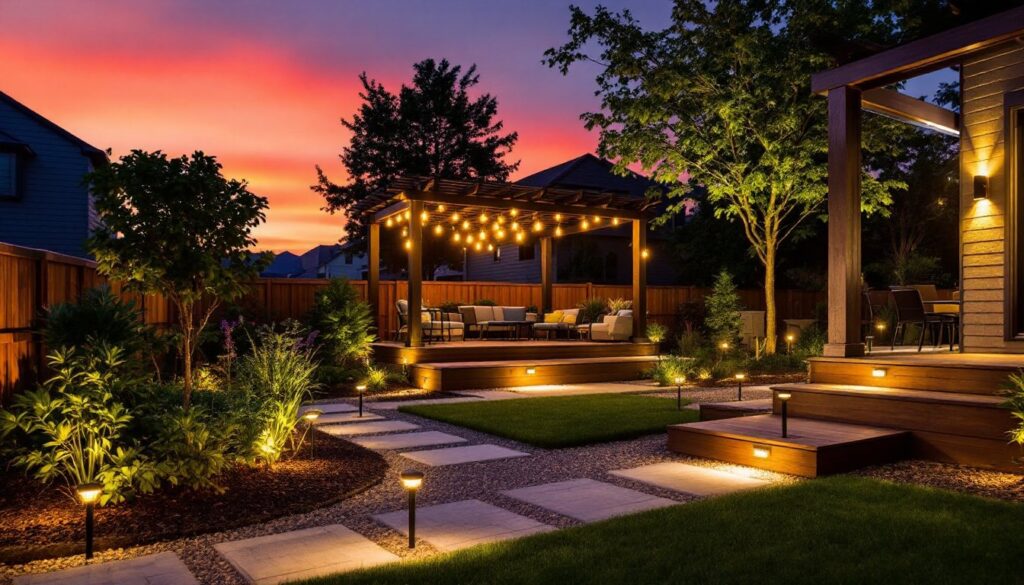
Place pathway lights every 3 to 4 feet along edges or at turns where foot traffic concentrates. In higher-traffic areas, closer spacing (every 2 feet) boosts safety and visibility. Most models deliver 20 to 50 lumens, enough to see your footing but not so bright they create harsh shadows.
Key considerations: Choose fixtures with tempered glass or clear acrylic lenses to resist impact and UV fade. Stainless steel or aluminum frames hold up better than plastic in wet climates. Expect battery replacement every 2 to 3 years: some models let you swap rechargeable AA or AAA cells without buying a whole new light. Budget roughly $8 to $20 per fixture, with larger quantities often discounted.
Solar String Lights and Decorative Overhead Ambiance
Solar string lights drape overhead between posts, trees, or pergolas to create intimate, warm-toned atmosphere for entertaining. They work well on decks, patios, and yards where you want layered lighting and soft decoration without the expense of permanent electrical runs.
Most solar string lights use LED “Edison” or globe-style bulbs and come in 20 to 100-light strands. Look for models rated IP65 or higher for water resistance: this rating means they handle rain and humidity without failure. Hanging height should clear head traffic by 7 to 8 feet minimum, test placement before permanently mounting hardware.
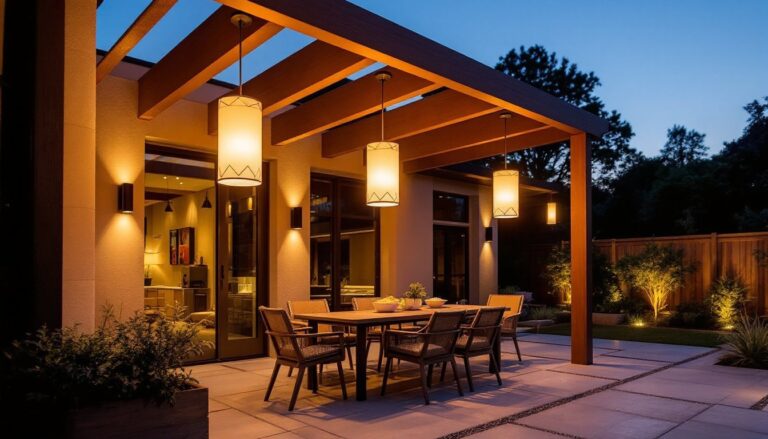
Installation requires sturdy anchor points. Use lag bolts or heavy-duty hooks rated for the strand’s weight plus wind load (usually 5 to 10 pounds per 50 feet). Check local codes: some jurisdictions require structural engineer approval for attachment to homes. outdoor solar lighting ideas can be enhanced by combining string lights with fixed overhead fixtures for layered illumination. Battery life on string lights runs 5 to 8 hours per charge in full sunlight: shorter nights or cloudy regions may reduce nightly runtime.
Solar Spotlights for Accent and Landscape Highlights
Spotlights use focused beams to highlight architectural details, specimen plants, sculptures, or water features. Unlike pathway lights’ soft ambient glow, spotlights project 100 to 500+ lumens in tight angles (typically 15 to 45 degrees).
Ground-mounted spotlights stake into soil or hardscape: wall-mounted or tree-mounted versions bolt to surfaces. Position spotlights at least 6 feet away from the feature you’re lighting to avoid harsh, washed-out appearance. Angle them upward for uplighting (drama and dimension) or horizontally for grazing light across texture.
Draw attention to specimen trees, stonework, or water features to frame views and extend sightlines into the yard after dark. Landscape lighting experts recommend a 3:1 ratio of ambient to accent lighting, spotlights should supplement pathway or general illumination, not be the only light. Quality solar spotlights cost $25 to $60 each, depending on brightness and weatherproofing.
Solar Wall Sconces and Fence-Mounted Fixtures
Wall sconces provide functional light near entries, transitions, and seating areas while adding architectural detail. Solar-powered sconces mount directly to siding, masonry, or fence rails without trenching or conduit, a major advantage over wired fixtures.
Choose sconces styled to match your home’s aesthetic: contemporary minimalist, transitional, rustic, or coastal designs exist at every price point. Most deliver 40 to 150 lumens with a 100-degree to 180-degree spread, enough to light an entryway or patio edge without overwhelming the space.
Mounting requires a drill and appropriate fasteners: stainless steel or coated screws for siding, concrete anchors for masonry. Aim for 6 to 8 feet above grade for balanced proportion and safety. Outdoor Wall Lighting Modern styles continue evolving with contemporary finishes and minimalist designs that blend seamlessly into modern landscaping. Check that the sconce has a manual or timer override, many models default to dusk-to-dawn operation, but you may want to control runtime during seasons when sunset varies dramatically.
Solar Deck and Patio Lights for Entertaining Spaces
Deck and patio lights create safe, inviting spaces for gatherings. Options include post-cap lights that sit atop deck railings, surface-mounted deck lights that screw into boards, and step lights embedded into riser edges.
Post-cap lights are popular for decks: they mount on top of 4×4 or 6×6 posts and cast light downward across the deck surface. Most models accept standard or solar LED inserts, letting you retrofit existing posts. Spacing post caps every 6 to 10 feet creates even, layered illumination without dark gaps.
Step lights mount into the face of a riser or stringer and mark stair edges, crucial for safety. Many homeowners combine post caps with step lights for comprehensive coverage. Pair deck lighting with outdoor ceiling lighting or overhead string lights to layer ambient and task lighting. Costs range from $15 per post-cap insert to $30 to $50 per premium fixture, with larger deck projects sometimes benefiting from contractor-grade bulk pricing.
Solar Motion-Sensor Lights for Security
Motion-activated solar lights detect movement within 30 to 50 feet (depending on the model) and trigger a bright LED, ideal for deterring unwanted activity and lighting dark corners when you approach.
Look for sensors with adjustable sensitivity and nighttime-only mode. Nighttime-only prevents false triggers from passing vehicles or animals during daytime. Sensitivity adjustment lets you tune out pet traffic while catching human movement. Most motion lights deliver 300 to 1000 lumens, much brighter than ambient pathway lights, for genuine security coverage.
Mount them on walls, fence posts, or trees near entryways, side yards, and blind corners. Position sensors to face foot traffic patterns and avoid pointing directly at reflective surfaces (which cause false triggers). Battery runtime in motion mode is excellent, since the light stays off until triggered, a single charge lasts weeks or months in low-activity areas. Solar Street Lighting concepts apply at home scale: the same principles of brightness, coverage, and timer functions work for residential security. Budget $30 to $100 per fixture for reliable motion-activated models.
Tips for Maximizing Solar Lighting Performance
Solar lights underperform when blocked from sunlight. Check each location between 9 a.m. and 3 p.m. for shadows from trees, buildings, or structures. Move fixtures if shade creeps across them during part of the day, even partial shade cuts output by 30 to 50 percent.
Clean panels monthly with a soft, damp cloth. Dust, pollen, and bird droppings reduce charging efficiency significantly. In winter or cloudy regions, supplement with battery backups or hybrid fixtures (solar plus small plug-in chargers) to maintain dusk-to-dawn operation.
Acclimate batteries: new rechargeable cells need two to three full charge-discharge cycles before reaching rated capacity. Leave new lights in sunlight for 3 to 5 days before first use. Swap batteries every 2 to 3 years, depending on climate and use, wet regions see faster degradation. Check product specs for CCT (color temperature): warm white (2700K) feels welcoming: cool white (5000K or above) appears more clinical. For entertaining and residential spaces, warm tones usually feel more inviting. Design principles from Southern Living and Hunker emphasize layered outdoor lighting, combining pathway, accent, and ambient fixtures creates depth and functionality. Test layouts with a few lights before buying a full system: this prevents expensive overbuying or poor placement.