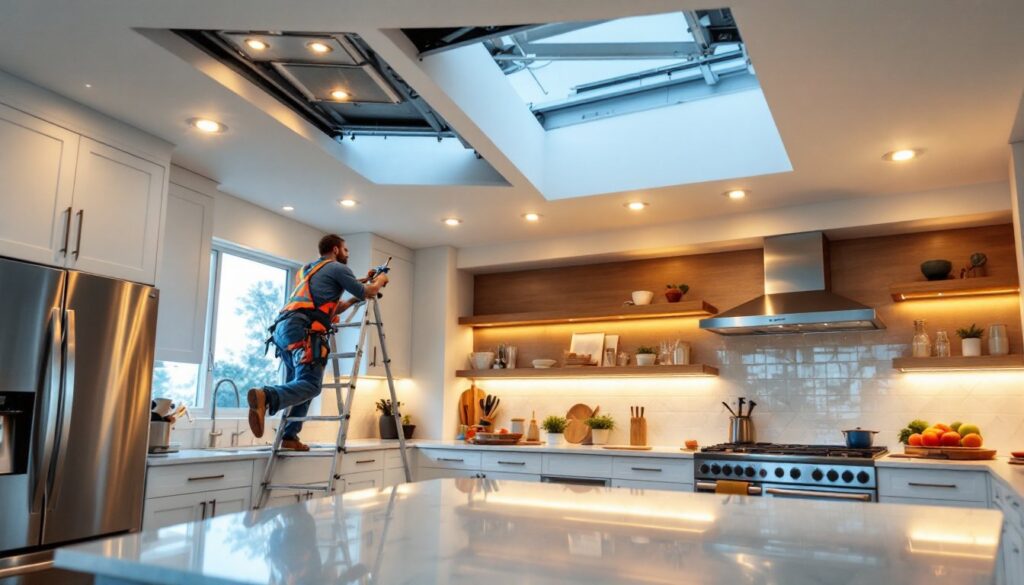
Recessed lighting transforms how a space feels, it’s subtle, clean, and works in almost any room when installed correctly. But “commercial” recessed lighting isn’t just for office buildings. Homeowners are increasingly adopting commercial-grade fixtures to get better light quality, durability, and reliability than standard residential options. Whether you’re planning a kitchen remodel, finishing a basement, or upgrading a living room, understanding commercial recessed lighting helps you make informed choices about fixtures, layout, and whether you’re hiring an electrician or tackling prep work yourself.
Table of Contents
ToggleKey Takeaways
- Commercial recessed lighting offers superior durability, thermal management, and light consistency compared to residential fixtures, making it ideal for kitchens, bathrooms, and high-use areas.
- Proper spacing (5–8 feet apart for 8-foot ceilings) and layered lighting design prevent dark spots and glare while creating a professional appearance.
- IC-rated (insulation contact) housings are essential where insulation touches your ceiling cavity; verify local building codes before installation.
- LED integration in commercial recessed lighting requires confirming dimmer compatibility to avoid flicker, and choosing bulbs with a CRI of 90 or higher for accurate color rendering.
- Always obtain permits and have electrical work inspected by a licensed professional; undersized wire, improper grounding, and code violations create fire hazards and complicate future home sales.
What Is Commercial Recessed Lighting and Why It Matters
Commercial recessed lighting refers to fixtures designed for durability and performance in high-traffic, temperature-variable environments, but those same qualities make them excellent for residential spaces. Unlike basic residential fixtures, commercial-grade units typically feature heavier-duty trims, better thermal management, and compatibility with standard commercial electrical specifications.
These fixtures sit flush with the ceiling, creating a seamless look that makes rooms feel larger and brighter. The fixture itself, called the housing, mounts above the ceiling, while only a trim ring and lens are visible below. Commercial versions often use aluminum housings instead of plastic, offering better heat dissipation and longer fixture life. They’re built to handle frequent on-off cycling and dimming without early failure.
Why choose commercial over residential? Commercial fixtures tend to deliver consistent light output, support better color rendering (how accurately they display colors), and work reliably with modern dimmers and smart home systems. For kitchens, bathrooms, and display areas where you’re spending money on finishes, commercial recessed lighting pays dividends in reliability and aesthetics.
Key Types and Styles of Recessed Fixtures
Recessed fixtures come in several configurations, each suited to different ceiling types and aesthetic goals. The main variable is how the housing mounts and what trim options are available.
New construction housing is the easiest to install, you install it before drywall goes up, securing it directly to joists. Remodel housing (also called IC-rated housing or old work fixtures) uses spring clips or brackets that grip from below, designed for retrofitting into finished ceilings. This is what most homeowners deal with during renovations.
IC-rated (insulation contact) housings are essential if your ceiling cavity touches insulation: they’re built to handle heat without creating a fire risk. Standard non-IC housings require air clearance around them, typically 3 inches minimum. Check your local building code (usually the IRC, International Residential Code) and confirm what your jurisdiction requires.
The trim you choose affects both light distribution and appearance. Baffle trims (with a conical insert) reduce glare: reflector trims maximize light output: and adjustable trims let you angle the light. For a clean, modern look, you might choose a flush trim with a narrow bezel. For commercial applications in retail or office-like spaces at home, consider a more substantial trim that projects slightly below the ceiling.
Trim and Housing Options
Recessed fixtures use interchangeable trims, meaning you can often swap out the trim without replacing the housing. Common options include baffle trim (reduces glare, better for task lighting), reflector trim (maximizes brightness, good for general illumination), adjustable trim (lets you tilt the light up to 30 degrees), and gimbal trim (similar to adjustable, rotates 360 degrees).
Commericial recessed lighting typically supports standard GU10, E26 (medium base), or MR16 lamp types. LED integration is increasingly common, some commercial fixtures come with integrated LED modules that can’t be changed, while others accept interchangeable LED bulbs. Integrated LEDs tend to be more efficient and have better thermal control, but they’re harder to upgrade later. Verify the CRI (Color Rendering Index), aim for 90 or higher for spaces where color accuracy matters (kitchens, bathrooms, living areas).
The color temperature (measured in Kelvins) sets the mood: 2700K feels warm and residential: 3000K is neutral and popular in commercial kitchens: 4000K is cool and energizing, good for task areas. Most homeowners blend 2700K or 3000K for living spaces.
Lighting Design Principles for Optimal Results
Professional lighting designers follow specific rules to avoid dark spots, glare, and wasted fixtures. You don’t need to be a designer, but understanding these basics saves money and frustration.
Aim for layered lighting. Recessed fixtures alone create a flat, shadowless look. Pair them with task lighting (under-cabinet strips, vanity lights), accent lighting (wall sconces), or ambient sources (table lamps) for depth and flexibility. Commercial recessed lighting often serves as the base layer, with other fixtures handling accent and task work.
Lumens matter more than wattage. Old specs used watts: modern lighting uses lumens (brightness) and efficacy (lumens per watt). A 12W LED might produce 1200 lumens, equivalent to a 100W incandescent. For residential areas, 400–600 lumens per fixture is typical for general lighting: higher-traffic kitchens might need 600–800 per fixture.
Dimming compatibility is crucial. If you want dimmer switches (and you should, it adds flexibility), confirm your LED bulbs and dimmer work together. Cheap LEDs and standard dimmers cause flicker. Commercial-grade LEDs are usually dimmer-compatible from 10–100%, giving smooth light control. Confirm the fixture specifications before purchasing.
Spacing, Placement, and Light Distribution
Proper spacing prevents dark spots and overlapping pools of light. A common rule: for general illumination, space fixtures 5–8 feet apart for 8-foot ceilings, increasing the spacing slightly for taller ceilings. In kitchens, you might need tighter spacing (4–6 feet) for adequate task lighting.
For kitchens, plan fixtures over work zones (counters, islands) and avoid spacing them directly above seating where they’d create uncomfortable shadows or glare. The formula most professionals use is: fixture spacing = ceiling height ÷ 0.5 to 0.7. For an 8-foot ceiling, that’s roughly 11–16 feet maximum distance from the wall to the first fixture, and 5–8 feet between fixtures.
Avoid placing fixtures over where people sit. Overhead light creates unflattering shadows on faces. Instead, position them 12–18 inches out from walls and offset them from primary seating areas. In offices or commercial kitchens (if you’re designing a home office or hobby area), keep fixtures in a grid pattern for uniform, even light.
Test spacing with paper templates on the ceiling before cutting holes. Many DIYers wish they’d done this step. Mark fixture positions with tape and take photos: live in the space for a few days with the lights on mentally positioned where you’ve marked. You’ll catch spacing mistakes before cutting.
Installation Guide: Planning and Best Practices
Installation complexity depends on whether you’re working with new construction (easier) or retrofitting into a finished ceiling. New construction recessed lighting requires running electrical before drywall: retrofitting requires cutting holes in a finished ceiling and fishing wires to a power source.
Planning and Permit Requirements
Check your local building department before starting. Most jurisdictions require permits for any new electrical work, even if you’re not doing the wiring yourself. Some allow homeowners to wire their own circuits under inspection: others don’t. Expect the electrical work to be licensed and inspected, particularly if you’re on a circuit with existing loads or extending circuits into new areas.
Calculate your circuit load: a 20-amp circuit can safely handle about 2400 watts continuous load (using 80% rule). With LED, power draw is minimal, but you’re limited by what you’re switching and how many fixtures you’re running. If you’re retrofitting into an existing circuit, confirm the circuit has capacity. A licensed electrician’s time is worth the cost here, oversized circuits, shared neutrals, and improper grounding cause fires.
Materials and Tools You’ll Need
For retrofit (remodel) fixtures: recessed light housing with IC rating (confirm it fits your ceiling cavity), trim ring and lens, integrated LED module or socket for LED bulb, drywall saw or hole saw (6–8 inches, depending on trim), wire strippers, wire nuts, electrical tape, attic access or ladder, flashlight, voltage tester, and measuring tape.
For new construction: new construction housing (secured to joists), wire, connectors, tape, and basic electrician tools. If running new wire, use 12 AWG for 20-amp circuits or 14 AWG for 15-amp. Confirm local code.
Step-by-Step Retrofit Installation (General Overview)
- Cut holes. Measure and mark fixture positions carefully. Use a drywall saw or hole saw, cutting from below the ceiling. Turn off power to the circuit before starting.
- Run wire. Route power to the fixture location. This often means fishing wire through the ceiling cavity from an existing outlet or switch box. This step is easiest with two people, one in the attic, one below.
- Mount the housing. Retrofit housings use spring clips or brackets that grip the drywall from above. Push the housing up from below, and the clips expand inside the cavity, gripping the drywall.
- Make electrical connections. Strip the wire, twist the fixture’s lead wires to your branch circuit wire, and secure with wire nuts. Tape connections for safety. Confirm polarity (black to black, white to white, bare copper or green ground to housing ground).
- Install the trim. Snap or screw the trim ring into the housing, add the lens, and test.
- Inspection. Have the work inspected by your local electrical inspector before closing the ceiling. (Do not seal up drywall or insulation over new fixtures until inspection passes.)
Safety Warnings
Turn off power at the breaker before working near any wires or fixtures. Use a voltage tester to confirm the circuit is dead, don’t rely on the breaker alone. Wear gloves and eye protection when working in attics or around insulation. Never install non-IC-rated fixtures in contact with insulation. If you’re unsure about electrical work, hire a licensed electrician. Building departments catch unpermitted work during resales and inspections: it’s cheaper and safer to do it right the first time.
Common Mistakes to Avoid
- Undersizing wire. Use the correct gauge: undersized wire overheats and causes fires.
- Mixing fixture types. Don’t combine IC and non-IC fixtures on the same circuit or in the same ceiling cavity.
- Skipping the attic check. Look above the ceiling before cutting. You might hit joists, ducts, or plumbing.
- Installing too many fixtures on one circuit. Even with LED, confirm you have capacity.
- Choosing cheap dimmers with LED bulbs. They flicker and fail early. Spend a few extra dollars on dimmer-rated LED bulbs and quality dimmers.
For detailed housing information and retrofit-specific guidance, the Recessed Lighting Housing: A Comprehensive Guide covers installation techniques in depth. Forums like Fine Homebuilding and resources at This Old House offer real-world retrofit examples and troubleshooting tips.
If you’re designing a commercial-style space at home, say, a retail display area or serious home office, Hlb Lighting: Shedding Light on the Future of Illumination explores advanced lighting systems that blend commercial and residential aesthetics. And for kitchens or areas needing task lighting layers, pairing recessed fixtures with Installing Under Cabinet Lighting: Brighten Your Space with Ease creates professional results.
Conclusion
Commercial recessed lighting delivers durability, light quality, and design flexibility that standard residential fixtures can’t match. By understanding fixture types, spacing rules, and installation requirements, you’ll make choices that serve your space well for years. Whether you’re hiring an electrician or handling prep work yourself, proper planning, including permits, spacing templates, and honest assessment of the electrical work involved, sets the stage for a polished, professional result. When in doubt, bring in licensed professionals: the cost is an investment in safety and code compliance.